Seville's Most Beautiful Photo Locations
Seville is one of the most photogenic cities in the world, and I know exactly where to take you. The Plaza de España with its tiled bridges and reflections, the Real Alcázar's palace courtyards, the winding streets of Barrio Santa Cruz, the Cathedral and Giralda, the Metropol Parasol, and the riverside views of Triana — each offers a completely different backdrop for your session.
Not sure where to shoot? I'll recommend the perfect locations based on your style, the time of day, and the light — so every photo looks its best.
Planning to pop the question? Read my guide to the best places to propose in Seville.


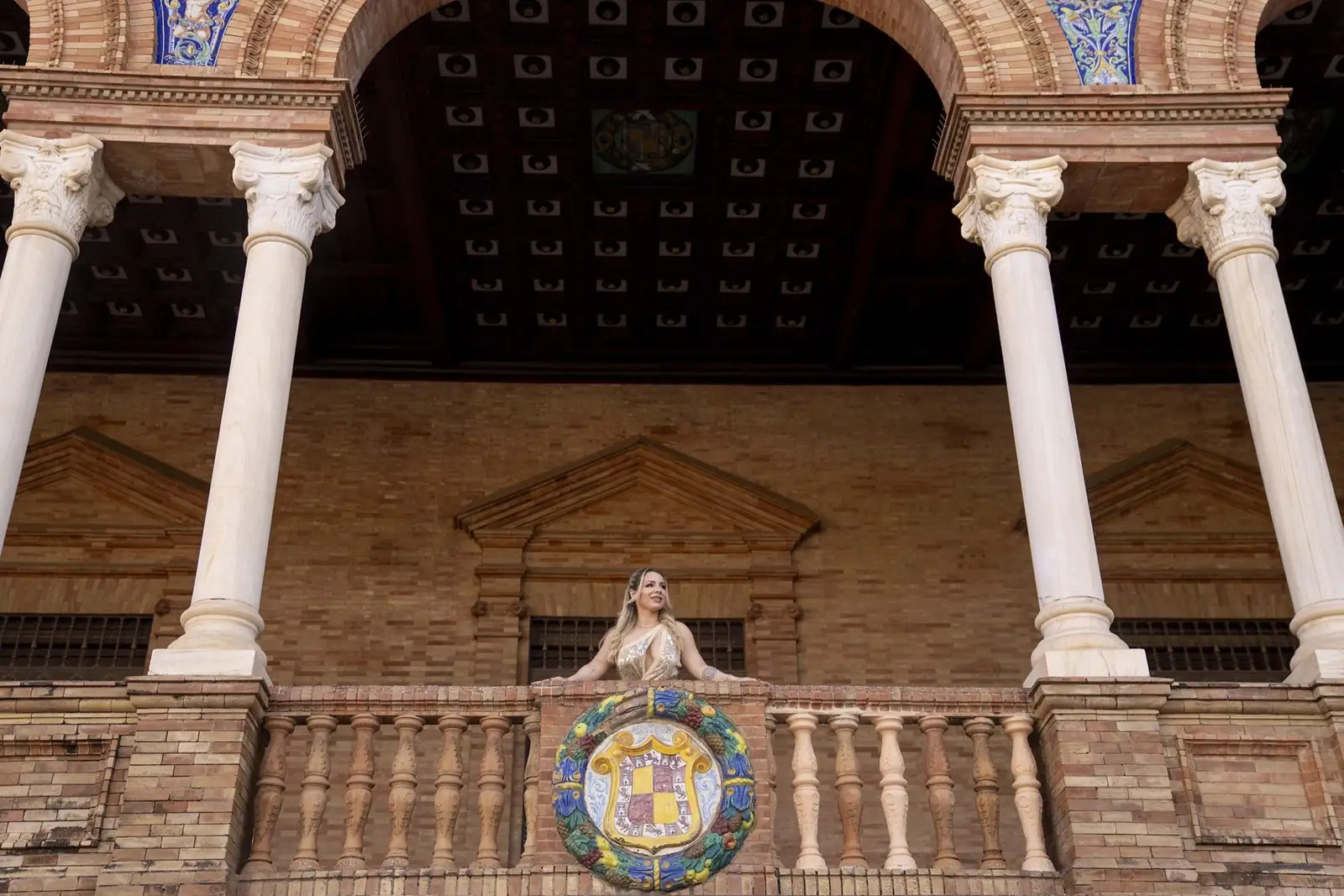


Plaza de España — The One Everybody Comes For
If you only shoot in one place in Seville, it is this one. The half-moon of tiled alcoves, the bridges arching over the canal, the towers at either end — it is grand enough to carry a photograph on its own, and large enough that a group can move around without feeling boxed in. Go at sunrise and you can have the whole curve almost to yourself; arrive at midday and you are sharing it with tour groups and horse carriages. It suits everything: proposals, families, solo portraits, flowing dresses that catch the light. The full guide is on the Plaza de España proposal page, and it covers where the light falls at each hour and which alcoves photograph best.
The Real Alcázar — Gardens, Arches and Shade
The Alcázar is Seville's Moorish palace, and its gardens are the best answer the city has to harsh midday sun. Orange trees, tiled pools, deep colonnades and hedged walkways give you shade and texture in the same frame, which is why it is my usual suggestion for summer sessions that cannot happen at dawn. Entry is ticketed and slots sell out in high season, so it needs booking ahead — and there are rules about tripods and commercial shoots that are worth knowing before you arrive. See the Real Alcázar guide for the detail, and the Seville photography permits page for what is and isn't allowed.
Barrio Santa Cruz — Whitewashed Lanes and Iron Balconies
The old Jewish quarter is the most intimate place to photograph in Seville: narrow lanes barely two people wide, whitewashed walls, geraniums spilling off wrought-iron balconies, and small squares that open up without warning. It is a completely different register from the Plaza de España — close, warm, textural — and it works beautifully for couples and for anyone who wants photographs that feel like the city rather than like a monument. The catch is timing. By late morning the alleys fill with walking tours and the light goes flat between the buildings. Early is essential. More on the Santa Cruz guide.
The Cathedral and the Giralda
The Cathedral is the most recognisable silhouette in Seville, and the Giralda tower behind it makes any frame instantly legible as this city and nowhere else. The best angles are not from directly in front — the building is too large to sit in a portrait — but from the Plaza del Triunfo, from the orange-tree courtyard, and from the streets that open onto it from Santa Cruz. It is busy almost all day, which makes early morning the only reliable window. Read the Cathedral proposal guide for the specific spots that work.
Triana and the Riverside
Cross the Isabel II bridge and Seville changes character. Triana is the old ceramics and flamenco quarter, and it gives you things the centre cannot: water, open sky, the bridge itself, tiled facades, and the long riverside walk with the Torre del Oro on the far bank. Sunset here is the best light in the city, because the river opens up the western horizon and nothing blocks it. It is also the most relaxed place to shoot — fewer crowds, more room, and a neighbourhood that feels lived-in rather than visited. See the Triana guide.
The Metropol Parasol (Las Setas)
Las Setas is the modern counterpoint to everything else on this list — an enormous timber lattice over the Plaza de la Encarnación, all curves and hard geometric shadow. Photographed from underneath it is dramatic and graphic in a way no amount of tilework can be, and it gives a session visual variety that stops everything looking like the same golden-stone city. The walkway on top is ticketed and gives you rooftop views across Seville, which is a strong ending to an evening session. The Metropol Parasol guide has the details.
María Luisa Park
The park wraps around the Plaza de España, and most people walk straight past it on the way in. That is a mistake. It is full of shaded paths, tiled benches, fountains, and small pavilions, and because visitors head for the Plaza it stays quiet even when the Plaza is heaving. It costs nothing to add — it is a two-minute walk — and it doubles the number of distinct backdrops you get from a single stop. I almost always work it into a Plaza de España session. The María Luisa Park guide has the details.
Three Quieter Alternatives
If the famous spots sound too busy for what you have in mind, three places take the pressure off. Plaza de América sits at the far end of María Luisa Park — same 1929 exposition, same architect as the Plaza de España, and a fraction of the people. Plaza del Cabildo is a frescoed semicircular arcade thirty seconds from the Cathedral that most visitors walk straight past. And Casa de Pilatos gives you courtyards and tilework on a par with the Alcázar, in a palace with a fraction of the queue. All three work well as the quiet half of a session that finishes somewhere grander.
How to Combine Locations in One Session
Walking time is real and it eats your light, so the route matters as much as the list. Santa Cruz, the Cathedral and the Plaza del Triunfo sit within a few minutes of each other and make a natural cluster. The Plaza de España and María Luisa Park are a second cluster, about fifteen minutes' walk from the first. Triana is across the river and adds twenty minutes each way, so it belongs at the start or the end, not the middle. Las Setas sits north of the Cathedral and pairs well with Santa Cruz. In one hour you can properly cover one cluster. In two hours you can do two, with an outfit change in between. Trying to fit in three means spending most of your session walking.
Timing, Crowds and Light
The single biggest factor in how your photographs look is not the location — it is when you shoot. Sunrise gives you empty streets and soft, low, directional light, and in summer it is the only comfortable option. The hour before sunset gives you the same warm light with more people in the frame. Midday between June and September is genuinely hard: hard overhead shadows, bleached stone, and heat that shortens everyone's patience. From November to March the sun stays low enough that good light lasts most of the day, crowds thin out, and booking is far easier. If you can choose your dates, late April or October give you the best combination of light, temperature and manageable crowds.
Choosing the Right Spot for Your Session
Which location suits you depends on what you are shooting. Proposals need somewhere I can work discreetly from a distance before stepping in — the Plaza de España and the riverside are ideal, and the proposal photography page explains how that works in practice. Families with small children need space and shade, which points to the Plaza and María Luisa Park; see family and couples sessions. Solo and travel portraits benefit most from variety, so a two-cluster route works best — that is covered on the vacation portrait page. If you are still deciding, tell me the date, the time you have available and who is being photographed, and I will put a route together. The contact page is the quickest way, and what to wear is worth reading before you pack.
